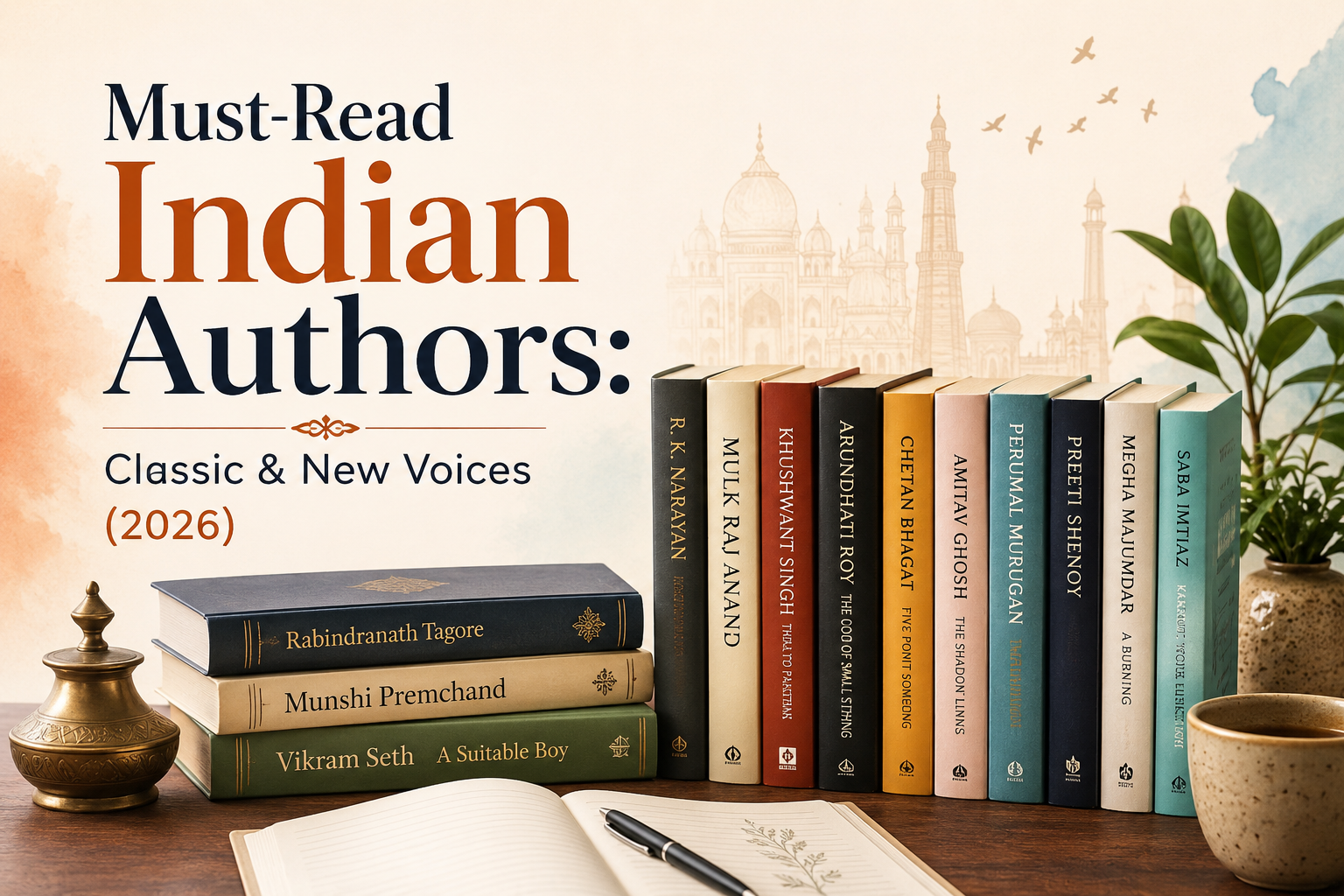
Your definitive guide to the best Indian authors to read — spanning Hindi fiction, Indian English literature, and the new-era voices rewriting the rules today.
India has never had a shortage of storytellers. Long before the printing press arrived, stories travelled through songs, epics, and oral traditions that stretched across thousands of years and dozens of languages. Today, that tradition lives on — in Hindi, English, Bengali, Marathi, Tamil, and beyond — through writers who are redefining what Indian literature means to a global audience.
Whether you are new to Indian writing or a committed reader looking to fill the gaps on your shelf, this guide covers the must-read Indian authors across every era: the classic masters who built the foundation, the modern giants whose work changed how India sees itself, and the new Indian authors of 2024 and 2025 who are just beginning to leave their mark. From famous Hindi authors to Booker Prize winners writing in English, this is the only list you need.
Classic Indian Literature: The Writers Who Built the Foundation
Munshi Premchand (Hindi) | Social Realism, Short Stories, Novels
No guide to the best Indian authors to read is complete without Munshi Premchand. Often called the Upanyas Samrat — Emperor of Novels — Premchand wrote in both Hindi and Urdu and spent his career giving voice to the poor, the oppressed, and the forgotten. His novel Godaan (The Gift of a Cow) remains one of the finest portraits of rural India ever written. His short stories — Kafan, Poos Ki Raat, Namak Ka Daroga — are studied in schools across India for good reason: they are devastating, human, and completely timeless.
Among the best Hindi novels to read for anyone new to Hindi fiction, Godaan is the essential starting point.
Start with: Godaan or the short story collection Maan Sarovar
Rabindranath Tagore (Bengali/English) | Poetry, Fiction, Philosophy, Drama
Rabindranath Tagore was the first non-European to win the Nobel Prize in Literature (1913), and his work remains among the most spiritually and intellectually rich in classic Indian literature. His poetry collection Gitanjali brought him world fame, but his novels — Gora, Ghare Baire (The Home and the World) — reveal a mind deeply engaged with nationalism, identity, and the position of women in society. Tagore is the entry point for readers exploring Indian literature for beginners: accessible, profound, and quietly overwhelming.
Start with: Gitanjali (poetry) or The Home and the World (novel)
R.K. Narayan (English) | Literary Fiction, Humour
R.K. Narayan created the fictional town of Malgudi and spent decades populating it with some of the most warmly drawn characters in Indian English literature. His novels — The Guide, Swami and Friends, The Bachelor of Arts — are deceptively simple in style but carry profound insight into ordinary Indian life. The Guide won the Sahitya Akademi Award in 1960 and remains a masterpiece of post-independence Indian fiction. For readers asking where to start with classic Indian literature books in English, Narayan is the answer.
Start with: The Guide or Swami and Friends
Ismat Chughtai (Urdu/Hindi) | Feminist Fiction, Social Realism
A fiercely independent writer who wrote about female desire, class, and gender at a time when doing so was genuinely dangerous, Ismat Chughtai was put on trial for obscenity for her short story Lihaaf (The Quilt). She never backed down. Her fiction — sharp, ironic, and deeply empathetic — feels startlingly modern even today. She is one of the most important feminist Indian authors in the entire Hindi-Urdu canon, and one who is still widely underread outside South Asia.
Start with: The Quilt and Other Stories
Love Words, Play Wordle by Kitaab Paglu
Modern Giants: 20th-Century Indian Authors Still Essential Today
Arundhati Roy (English) | Literary Fiction, Political Non-Fiction
Arundhati Roy‘s debut novel The God of Small Things (1997) won the Booker Prize and became one of the best-selling books in the history of Indian publishing. Set in Kerala, it tells the story of twins navigating caste, forbidden love, and family tragedy in language so lyrical it reads almost like poetry. Her second novel, The Ministry of Utmost Happiness (2017), arrived two decades later — sprawling, political, and unlike anything else published that year.
Among Indian Booker Prize authors, Roy stands in a category of her own. Readers who love Toni Morrison or Gabriel García Márquez will find her work deeply familiar.
Start with: The God of Small Things
Vikram Seth (English) | Literary Fiction, Poetry, Verse Novel
Vikram Seth pulled off one of the most audacious feats in modern Indian English literature: A Suitable Boy (1993), a 1,349-page epic of post-partition India told through the lives of four families. It is one of the longest novels ever published in English and also one of the most readable — a sweeping portrait of postcolonial India that rewards every page. His verse novel The Golden Gate, written entirely in sonnets, is a separate kind of genius altogether.
Start with: A Suitable Boy
Amitav Ghosh (English) | Historical Fiction, Postcolonial Literature
Amitav Ghosh is India’s preeminent writer of historical fiction and one of the most globally celebrated Indian authors in English literature. His Ibis Trilogy — Sea of Poppies, River of Smoke, Flood of Fire — reconstructs the 19th-century opium trade with breathtaking detail and moral complexity. His non-fiction work The Great Derangement is essential reading on climate change and storytelling. Fans of Hilary Mantel or postcolonial literature will find Ghosh deeply rewarding.
Start with: Sea of Poppies or The Shadow Lines
Gulzar (Hindi/Urdu) | Poetry, Lyric Poetry, Film Writing
Gulzar is perhaps the most beloved living Hindi-language poet and lyricist — a name synonymous with contemporary Hindi poetry at its highest level. His poems move between grief and joy with a lightness that disguises their depth. His film lyrics — from Aandhi to Jai Ho — are recited by millions who may not even know they are reading poetry. For any reader serious about Hindi fiction and verse, his collections are non-negotiable.
Start with: Selected Poems (translated by Piyush Dimri Shah)
Mahasweta Devi (Bengali, translated to Hindi/English) | Political Fiction, Activist Literature
Mahasweta Devi spent her life writing about those at the margins of Indian society — tribal people, bonded labourers, the dispossessed. Her novella Breast-giver (Stanodayini) is one of the most powerful pieces of feminist Indian writing ever produced. She received the Jnanpith Award, India’s highest literary honour, and her work sits at the crossroads of political fiction and social realism India has rarely seen matched.
Start with: Breast Stories or Imaginary Maps
Contemporary Indian Writers: New Era Voices of 2024 and 2025
This is where Indian literature gets truly exciting. The new Indian authors writing today are more diverse, more formally bold, and more globally connected than any previous generation. Here are the contemporary Indian writers you need on your shelf right now.
Avni Doshi (English) | Psychological Literary Fiction
Avni Doshi‘s debut novel Burnt Sugar (2019) — published as Girl in White Cotton in India — was shortlisted for the Booker Prize in 2020 and announced one of the most important new voices in Indian English fiction. It is a savage, precise, unflinching examination of a mother-daughter relationship that refuses to be comfortable. Easily one of the finest Indian novels of its decade, it is essential reading for anyone tracking contemporary Indian writers in English.
Start with: Burnt Sugar
Perumal Murugan (Tamil, translated to Hindi and English) | Rural Literary Fiction, Social Realism
Perumal Murugan became internationally known when he announced his “death as a writer” in 2015 after his novel Madhorubhagan (One Part Woman) drew threats from right-wing groups. The Madras High Court later ruled in his favour. His work — deeply rooted in Tamil rural life, caste, and desire — is now widely available through sensitive translations. He bridges the world of classic Indian literature and contemporary writing with rare authority.
Start with: One Part Woman or Poonachi: Or the Story of a Black Goat
Prayaag Akbar (English) | Dystopian Literary Fiction
Prayaag Akbar‘s debut novel Leila (2017) — later adapted into a Netflix series — is one of the most unsettling dystopian novels to come out of India. Set in a future city rigidly divided by religion and caste, it asks questions about belonging and erasure that feel painfully relevant to contemporary India. It is the kind of book that lingers long after the last page. Among new Indian authors working in speculative and literary fiction, Akbar is a name to watch closely.
Start with: Leila
Anamika (Hindi) | Contemporary Hindi Poetry, Feminist Poetry
One of the most important voices in contemporary Hindi poetry, Anamika writes with a rare combination of classical learning and modern sensibility. Her poetry draws on everyday domestic experience and transforms it into something quietly revolutionary. She is essential reading for anyone serious about the current state of Hindi fiction and verse — and for readers interested in feminist Indian authors working today.
Start with: Anushtup or Khurduri Hatheliyan
Husain Haidry (Hindi/Urdu) | Spoken Word Poetry, Contemporary Urdu Nazm
Husain Haidry defines the new wave of Hindi-Urdu poetry reaching audiences through digital platforms and live performance. His work speaks directly to urban youth while honouring the tradition of the ghazal and nazm — classical forms reimagined for the social media age. He is perhaps the most exciting voice in contemporary Hindi poetry for readers under 35, and proof that the Urdu poetic tradition is very much alive.
Chetan Bhagat (English/Hindi) | Commercial Fiction, Campus Fiction
Love him or critique him, Chetan Bhagat is undeniably one of the most-read Indian authors of the 21st century. His debut Five Point Someone (2004) — later adapted into the film 3 Idiots — tapped into the anxieties of India’s middle-class youth in a way no previous Indian English novelist had managed. He writes for readers who might not otherwise pick up a novel, and that is a genuinely valuable thing.
Start with: Five Point Someone or 2 States
Sudha Murty (Kannada/English) | Inspirational Fiction, Short Stories, Memoirs
Sudha Murty writes with warmth, simplicity, and moral clarity. Her books — Wise and Otherwise, The Day I Stopped Drinking Milk, Gently Falls the Bakula — have sold millions of copies and introduced a generation of Indian readers to the pleasures of values-driven storytelling. She writes in both Kannada and English, and her works are widely translated. For readers looking for Indian literature for beginners that is immediately accessible, Sudha Murty is a perfect entry point.
Start with: Wise and Otherwise
Benyamin (Malayalam, translated to Hindi and English) | Literary Fiction, Migration Narratives
Benyamin‘s Aadujeevitham (Goat Days), the story of a Keralite migrant worker’s ordeal in a Saudi Arabian desert, has become one of the most powerful and widely translated regional Indian writing works of the modern era. Its recent film adaptation brought it to new international audiences, but the novel itself — harrowing, luminous, and impossible to put down — is the real experience. It is proof that the best Indian books to read are not always the ones with the loudest marketing.
Start with: Goat Days
Best Indian Books to Read by Genre: Quick-Reference Table
| Genre | Classic Pick | Contemporary Pick |
|---|---|---|
| Social Realism India | Premchand — Godaan | Perumal Murugan — One Part Woman |
| Literary Fiction (English) | R.K. Narayan — The Guide | Avni Doshi — Burnt Sugar |
| Historical Fiction | Amitav Ghosh — Sea of Poppies | Vikram Seth — A Suitable Boy |
| Poetry (Hindi/Urdu) | Gulzar — Selected Poems | Husain Haidry — spoken word collections |
| Feminist Indian Authors | Ismat Chughtai — The Quilt | Anamika — Anushtup |
| Dystopian Fiction | — | Prayaag Akbar — Leila |
| Inspirational / Family | Sudha Murty — Wise and Otherwise | Sudha Murty — The Day I Stopped Drinking Milk |
| Political Fiction | Mahasweta Devi — Imaginary Maps | Arundhati Roy — The Ministry of Utmost Happiness |
| Migration Narratives | — | Benyamin — Goat Days |
Indian Literature for Beginners: Where to Start
If you are new to Indian literature and want to start somewhere manageable and immediately rewarding, here are three entry points based on what you usually enjoy reading.
You like short reads: Start with Premchand’s short stories or Ismat Chughtai’s The Quilt. Both are brief, accessible, and will stay with you for years.
You like big, immersive novels: Go straight to A Suitable Boy by Vikram Seth or The God of Small Things by Arundhati Roy. Both are demanding in the best possible way.
You like poetry: Pick up Gulzar’s Selected Poems — you will finish it in an afternoon and return to it for years.
You want something recent: Avni Doshi’s Burnt Sugar or Prayaag Akbar’s Leila are among the best contemporary Indian writers in English working right now.
FAQ: Indian Authors and Literature
Who is the most famous Indian author? It depends on language and era. In Hindi literature, Munshi Premchand is universally considered the greatest. In Indian English fiction, Rabindranath Tagore (Nobel Prize, 1913) and Arundhati Roy (Booker Prize, 1997) are the most internationally recognised.
Which Indian author has won the Booker Prize? Several Indian Booker Prize authors have taken the award, including Arundhati Roy for The God of Small Things (1997), Aravind Adiga for The White Tiger (2008), and Avni Doshi was shortlisted in 2020 for Burnt Sugar.
What are the best Hindi novels to read? Start with Premchand’s Godaan, which is widely considered the greatest Hindi novel ever written. For contemporary Hindi fiction, Perumal Murugan’s translated works and Anamika’s poetry collections are essential.
Are there good Indian authors who write in both Hindi and English? Yes — several writers who write in Hindi also have work available in English translation. Premchand, Ismat Chughtai, Mahasweta Devi, and Gulzar all have excellent English translations available. Chetan Bhagat writes primarily in English but his work draws deeply from Hindi-speaking India.
Which Indian books are best for book clubs? A Suitable Boy by Vikram Seth, The God of Small Things by Arundhati Roy, and Goat Days by Benyamin are all excellent for book clubs — rich in theme, accessible in prose, and full of discussion-worthy ideas.
Who are the best new Indian authors to read in 2025? Avni Doshi, Prayaag Akbar, Husain Haidry, and Perumal Murugan (newly translated) represent the most exciting contemporary Indian writers working today.
Final Thoughts
Indian literature is not one thing. It is hundreds of languages, thousands of years of tradition, and a subcontinent of competing and complementary ideas about what a story can do. The must-read Indian authors listed here represent only a fraction of what is available — and that is exactly the point. Every book you read opens a door to three more.
The shelf you build from Indian writing will be one of the most varied, emotionally generous, and intellectually demanding shelves you own. Whether you start with classic Indian literature books or dive straight into the new era voices, start anywhere. Keep going.
Next Read: Why Every Bibliophile is Secretly Obsessed with Wordle
You Can Also Read This On Medium:
https://medium.com/@kitaabpaglu/must-read-indian-authors-classic-new-voices-2026-8c48013412a9