
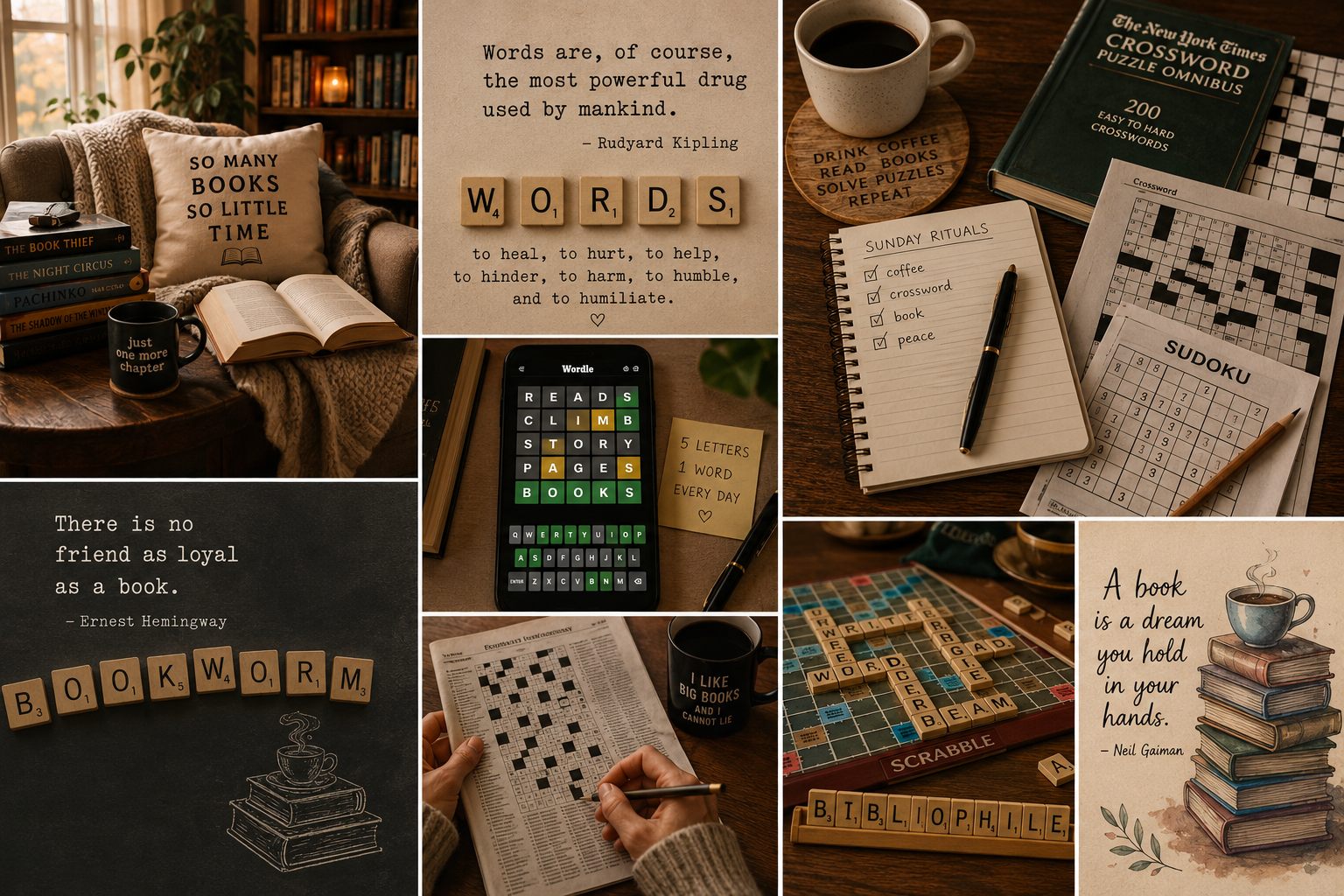
There is a specific kind of quiet that exists only in the home of a reader. It’s not a hollow silence; it’s a heavy, textured thing, filled with the invisible ghosts of stories and the faint scent of aging paper. You’ll usually find us there, tucked into a corner with a book pressed open. But look closer at the bedside table or the coffee-stained coaster, and you’ll likely find something else: a phone glowing with the day’s Wordle grid.
Why is it that those of us who spend our lives consuming words are so obsessed with deconstructing them in five-letter bursts?
It’s a curious overlap. You’d think that after spending eight hours navigating the dense prose of a Russian novel or the intricate stanzas of a ghazal, our brains would want a break from syntax. And yet, bibliophiles were the first people to jump on the Wordle bandwagon. The truth is, for a reader, a word is never just a collection of letters. It’s a texture, a history, and a tiny puzzle all on its own. We don’t just read language; we play with it, and this daily ritual has become the ultimate playground for the literary mind.
1. The Wordle Phenomenon: A Daily Romance with the Lexicon
To understand why readers love this game, you first have to understand how we look at words. To most, a word is just a tool for communication. To a reader, it’s a sensory experience. We hear the wind through the trees in sibilant sounds; we feel the weight of a heavy consonant on our tongues.
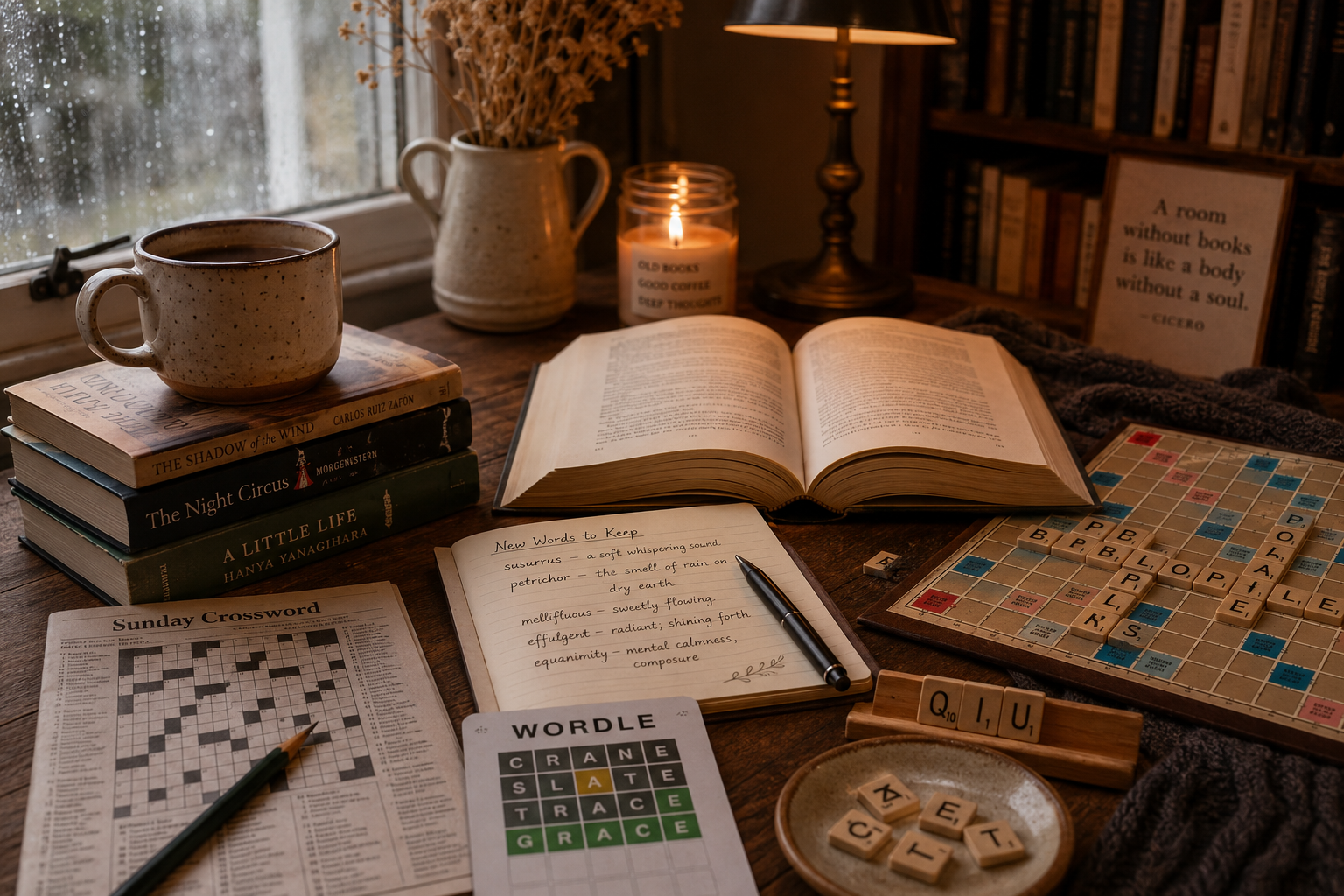
Bibliophiles are collectors of “orphaned” words—those beautiful, obscure terms that don’t get out much in polite conversation. When we encounter a word like petrichor or mellifluous in a story, we don’t just register its meaning; we tuck it away like a polished stone in a pocket. Wordle provides the perfect daily stage for this collection. There is a very specific, nerdy shot of adrenaline that hits when you realize your “passive” vocabulary—the words you’ve absorbed through years of reading—suddenly becomes the key to solving the day’s puzzle.
The Pattern in the Prose
Avid readers are naturally tuned to the rhythm of sentences. We notice the way a writer balances a long, flowing thought with a sharp, punchy finish. This makes us accidental experts at pattern recognition. When you spend years looking at how letters flow together to create mood, your brain starts to see the “skeleton” of language. That’s why a reader can look at a jumble of grey and yellow boxes and deduce the placement of a vowel almost instinctively. Our brains are conditioned to seek the harmony in the chaos of the alphabet.
2. The Psychology of the “Click”: Why Wordle Triggers Literary Pleasure
Have you ever been stuck on a difficult chapter? You carry the plot around in the back of your mind like a low-grade fever. Then, while you’re staring out the window, the character’s motivation finally makes sense. Aha!
That moment is what psychologists call the “Eureka effect.” It’s a literal dopamine hit.
For readers, the pleasure of solving a Wordle is familiar. It’s the same feeling we get when a mystery novelist finally reveals the killer, or when a poet connects two seemingly unrelated ideas in a way that makes your heart ache. The game shares the same psychological DNA as a good book: curiosity and discovery.
Why the Brain Craves the Five-Letter Puzzle
-
Cognitive Reward: Solving the daily grid provides a sense of order. In a world that often feels chaotic, finishing those five boxes offers a tiny, manageable victory.
-
The Hunt for Meaning: Readers are explorers by nature. We are used to digging through layers of subtext. A puzzle is simply a condensed version of that journey.
-
Mental Agility: Just as we exercise our bodies, we need to “stretch” our linguistic muscles. These games are the HIIT workout for the literary mind, keeping our vocabulary sharp for the next great novel we pick up.
3. How Reading Habits Build a Better Wordle Strategy
Let’s be honest: it’s a little bit satisfying to solve the puzzle in two tries because you happened to know an obscure word from a Victorian novel.
Reading is the ultimate training ground for language puzzles. Whether you’re a fan of high-fantasy world-building or gritty noir, every book you finish expands your internal dictionary. You pick up archaic terms from historical fiction and technical jargon from non-fiction.
This isn’t just about knowing “big” words. It’s about understanding nuance. A reader knows the difference between being content, satisfied, and sated. In a game where every letter counts, that ability to distinguish between subtle shades of meaning—and knowing which letters are likely to follow others based on thousands of pages of experience—is a genuine superpower.
Memory and Literary Echoes
Bibliophiles often have a “literary memory.” We remember words because of the emotional context in which we first found them. I might remember a specific five-letter word not because I studied a dictionary, but because of how it was used to describe a scene in a book I loved when I was twenty. When that word appears as a possibility in my daily game, it brings a whole atmosphere with it.
4. The Narrative of the Grid: Puzzles as Micro-Stories
We often think of word games as purely logical tasks, but for the bibliophile, they are narrative. We love stories, and Wordle allows us to be the lead character in a very short, very intense story every single day.
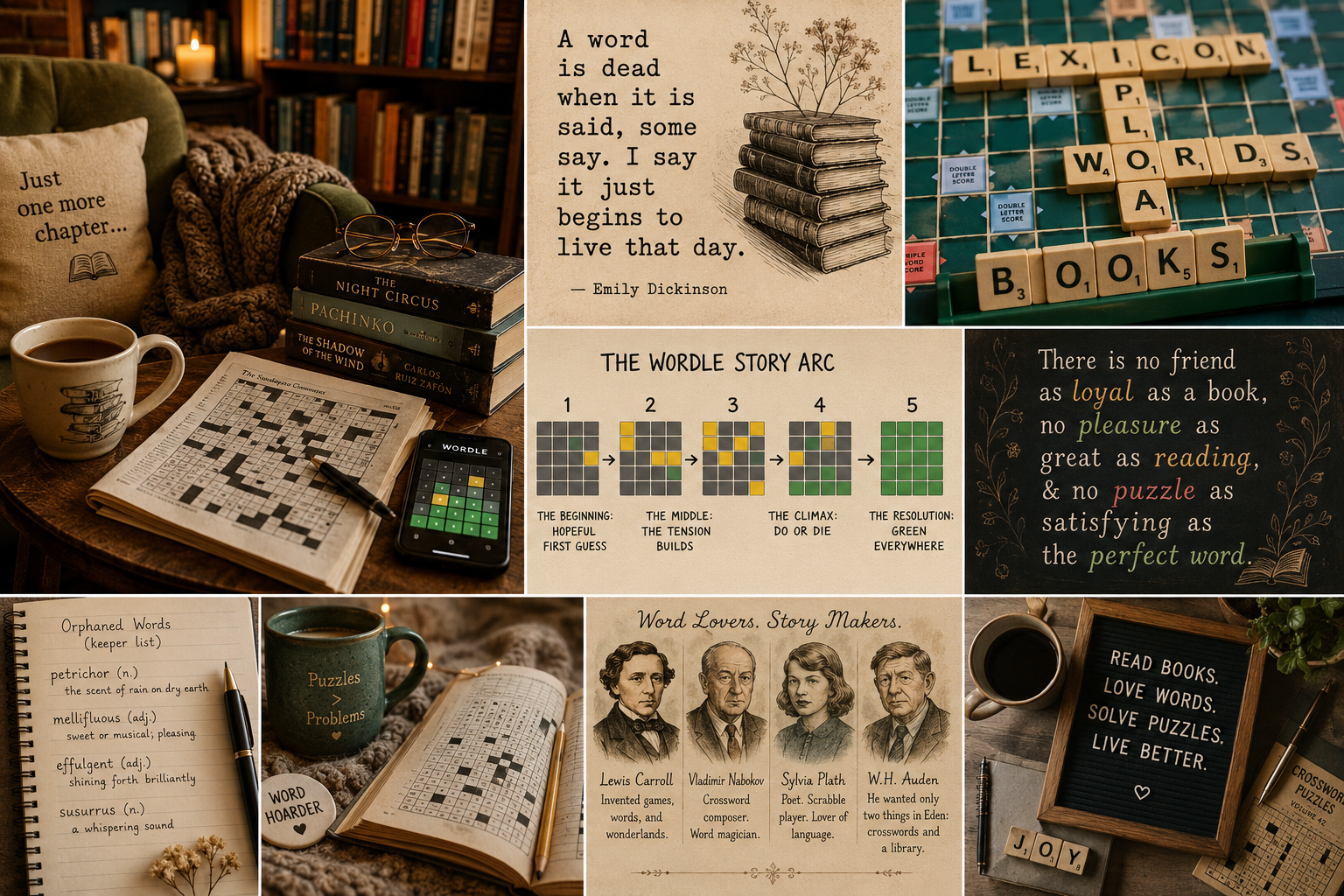
Think about the structure of a typical game:
-
The Beginning: The hopeful first guess—the “Inciting Incident.” You throw a word like ARISE or STARE into the void, hoping for a sign.
-
The Middle: The tension of the yellow and grey boxes—the “Rising Action.” This is where the conflict happens. You’re running out of rows, and the letters aren’t lining up.
-
The Climax: That do-or-die fifth or sixth guess where everything is on the line. Your heart rate actually picks up.
-
The Resolution: The boxes turn green in a satisfying wave. Peace is restored to the kingdom of your mind.
It is a complete story arc experienced in less than three minutes. For someone who lives for narrative, this daily “micro-story” is addictive.
Click/tap here to play wordle by Kitaab paglu
5. Community and the “Kitaab Paglu” Spirit
There’s a common misconception that reading is a lonely hobby. While the act itself is solitary, the culture is deeply social. We join book clubs, we haunt libraries, and we share our favorite passages.
The social aspect of Wordle is a perfect extension of this. Think about the phenomenon of sharing those little colored square grids on social media. Why did it take over the world? Because it gave us a shared language. It was a way to say, “I struggled with this today, too,” or “I found a beautiful word,” without having to say much at all.
Traditions and Connections
For many readers, the daily puzzle has become a digital “book club.” We text our results to our friends, our siblings, or our parents. It’s a bridge between generations. A grandfather might solve it using a word he remembers from a classic poem, while the granddaughter uses a word she saw in a modern screenplay. Together, they celebrate the same language.
In a world that is increasingly digital and disconnected, these games provide a low-stakes way to connect intellectually. They are “intellectual play,” a way to bond over our mutual love for the tools of communication. At Kitaab Paglu, we believe books bring people together—and these puzzles do exactly the same.
6. The “Cozy” Factor: Escapism in Green and Gold
There is something inherently “cozy” about a word puzzle. It belongs to the same world as rainy mornings, oversized sweaters, and steaming mugs of coffee.
For many bibliophiles, these games are a form of active meditation. When you are focused on finding that final letter, the stresses of the “real world”—the bills, the work emails, the news—fade into the background. It requires just enough focus to keep your mind from wandering into anxiety, but not so much that it feels like hard labor.
A Ritual for the Modern Reader
For the reader who spends all day looking at a screen for work, the transition into a “reading mind” can be difficult. Starting the morning with a language puzzle acts as a palette cleanser. It wakes up the part of the brain that appreciates syntax and spelling, preparing it for the deeper immersion of a novel later in the evening. It’s a ritual. It’s a way to slow down time and focus on the beauty of a single word.
7. Famous Writers and the Love of Wordplay
If you feel a bit “extra” for obsessing over your streak, take heart: you are in excellent company. Some of the greatest minds in literature were absolute fiends for wordplay and language puzzles.
-
Lewis Carroll: The man who gave us Alice in Wonderland was a mathematician and a wordplay genius. He invented his own games and filled his books with puns and portmanteaus. He would have been the first person to share his Wordle score in the morning.
-
Vladimir Nabokov: The author of Lolita was a master of the crossword and multilingual puns. He understood that language is a toy to be played with, not just a tool to be used.
-
Sylvia Plath: Known for her intense poetry, Plath was a passionate Scrabble player. She found the “clink” of the tiles and the strategic placement of letters a necessary distraction from the weight of her creative work.
-
W.H. Auden: The poet famously said that his idea of Eden included “the most difficult crosswords” and a “tremendous library.”
These writers understood that language isn’t static. It’s a living, breathing thing. By engaging with these puzzles, we are participating in the same tradition of linguistic curiosity that fueled some of the world’s most enduring literature.
8. Why Wordle is the Perfect Companion for Books
At the end of the day, why do we care so much about these five boxes?
I think it’s because bibliophiles understand that words are the only way we truly have to reach out and touch another human mind. When we read, we are connecting with an author’s thoughts from across time and space. When we play a word game, we are celebrating the architecture of those connections.
Every time we solve a puzzle, we are affirming that language has logic, beauty, and a sense of fun. It’s a reminder that even when the world feels nonsensical, the alphabet still follows certain rules. There is a place for every letter, and a meaning for every word.
So, the next time you find yourself ignoring your “To-Be-Read” pile because you’re determined to keep your streak alive, don’t feel guilty. You aren’t procrastinating. You’re just taking a moment to appreciate the magic of the tools that make your favorite stories possible.
Keep reading. Keep playing. And most importantly, keep finding the beauty in the letters.
Click/tap here to play wordle by Kitaab paglu
What about you? Are you a “start with the vowels” kind of player, or do you have a secret go-to starting word? Do you feel that your reading habits help you guess the daily word faster? Let’s talk about our favorite linguistic obsessions in the comments below!
This post originally appeared on Kitaab Paglu—Where Stories Find Their True Paglu.

[…] Next Read: Why Every Bibliophile is Secretly Obsessed with Wordle […]